



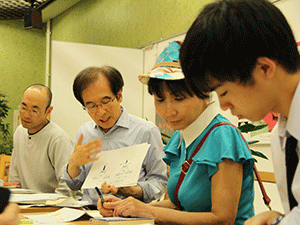
Jin Tada, an Aspire Leaders Program 2026 alumnus from Japan, is expanding access to environmental knowledge through the Water Storytellers Collective, an initiative that has grown from a grassroots civic technology project into an officially endorsed UN Ocean Decade Action Number 14.8.
Combining artificial intelligence, environmental data, and community knowledge, the initiative has reached more than 2,500 young people across 45 vulnerable coastal and rural communities while creating more than 100 localized green jobs. Now operating across Japan, the Philippines, Indonesia, and South Korea, the Collective is demonstrating how technology can strengthen communities when the people most affected by environmental challenges are given the tools and authority to shape the solutions.
Turning Complex Climate Data into Knowledge Communities Can Use
At the center of the Water Storytellers Collective is a challenge Tada describes as the “water data translation gap,” a structural barrier that can make sophisticated climate and environmental information difficult for frontline communities to access and use.
Scientific resources such as hydrological models and climate adaptation strategies contain information that can help communities prepare for environmental risks, but technical language and digital divides can prevent that knowledge from reaching the people who may need it most.
To bridge that gap, the Collective developed AI Carson, a generative artificial intelligence tool designed as a digital public good. Using a Retrieval-Augmented Generation architecture, the system translates complex environmental information into localized and culturally accessible narratives that communities can more readily understand and apply.
The project’s approach is not built around technology replacing human knowledge. Instead, Tada sees technology as most valuable when it creates stronger connections between scientific information and the knowledge communities have developed through lived experience.
From Climate Advocates to Community Data Scientists
As the Collective expanded, its impact moved beyond making environmental information more accessible. It began equipping young people with the technical skills to participate directly in how that information is collected, interpreted, and used.
Across 45 coastal and rural communities, more than 2,500 young people have participated in the initiative’s physical and digital capacity-building programs. Participants have received training in Geographic Information Systems mapping, water quality auditing, and advanced AI operation, helping them move from climate advocacy into more technical roles as citizen data scientists.
The initiative reports that this model has generated more than 100 localized green jobs, creating opportunities for young people to turn environmental knowledge into professional and economic participation.
One of the changes that has remained particularly meaningful to Tada has been watching young women take on greater authority within traditionally male-dominated maritime and agricultural environments. By learning to operate AI Carson and interpret environmental data, they have been able to facilitate conversations between scientific models and community knowledge.
“Seeing them confidently cross-reference predictive climate models with veteran farmers to co-design climate resilience strategies reaffirmed my foundational belief in Relational STEM, the philosophy that technological innovation must be utilized to expand human capabilities, ensure environmental justice, and dismantle systemic inequalities.” For Tada, those moments illustrate a larger purpose behind the technology: not simply giving communities access to information, but expanding who has the skills and authority to participate in decisions about their environmental future.
When Generations of Knowledge Meet Artificial Intelligence
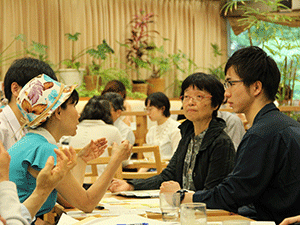
That philosophy became particularly visible during a Kankyo Cafe intergenerational workshop in Tokyo.
The workshop brought young participants working with environmental data into conversation with veteran coastal fishers whose understanding of local waterways had been shaped by decades of lived experience. Initially, the two forms of knowledge did not easily align. Some older participants felt that satellite models and quantitative data risked overlooking the Traditional Ecological Knowledge their communities had accumulated across generations.
Rather than positioning the technology as the final authority, the Collective’s framework of algorithmic stewardship gave community elders the ability to critique, correct, and validate AI-generated predictions using their historical understanding of tides, rivers, and local environmental patterns.
During the workshop, an 80-year-old fisher who had initially been highly skeptical of the technology identified and corrected an inaccurate satellite-derived flood map. The moment changed the way he viewed the relationship between technology and his own knowledge.
Tada recalled the fisher explaining that, for the first time, the machines did not feel as though they were there to replace his memory or tell him that his knowledge had become obsolete. Instead, he saw young people using technology to demonstrate that the knowledge accumulated throughout his life still mattered.
The exchange captured what the Collective hopes community-led technology can accomplish. Instead of asking communities to choose between scientific innovation and traditional knowledge, its model creates space for each to challenge and strengthen the other.
Building a Global Pathway for Frontline Youth
The Water Storytellers Collective is now moving from regional expansion toward greater participation in international climate and water policy.
Leading up to the 2026 UN Water Conference, Tada is working to establish a Global Opportunity Hub, a peer-led pathway intended to connect marginalized young people across the Asia-Pacific with fully funded opportunities to participate in multilateral forums.
That work intersects with several of his current international roles, including serving as an Expert Reviewer for the IPCC AR7, Global Coordinator for the Youth Global Leadership Platform under CIFAL Japan, and a GYWEP Youth Envoy.
His longer-term goal is to help frontline communities gain both the technical knowledge and diplomatic agency needed to advocate for greater community control over predictive water data and for community-led algorithmic stewardship to become part of global climate adaptation frameworks.