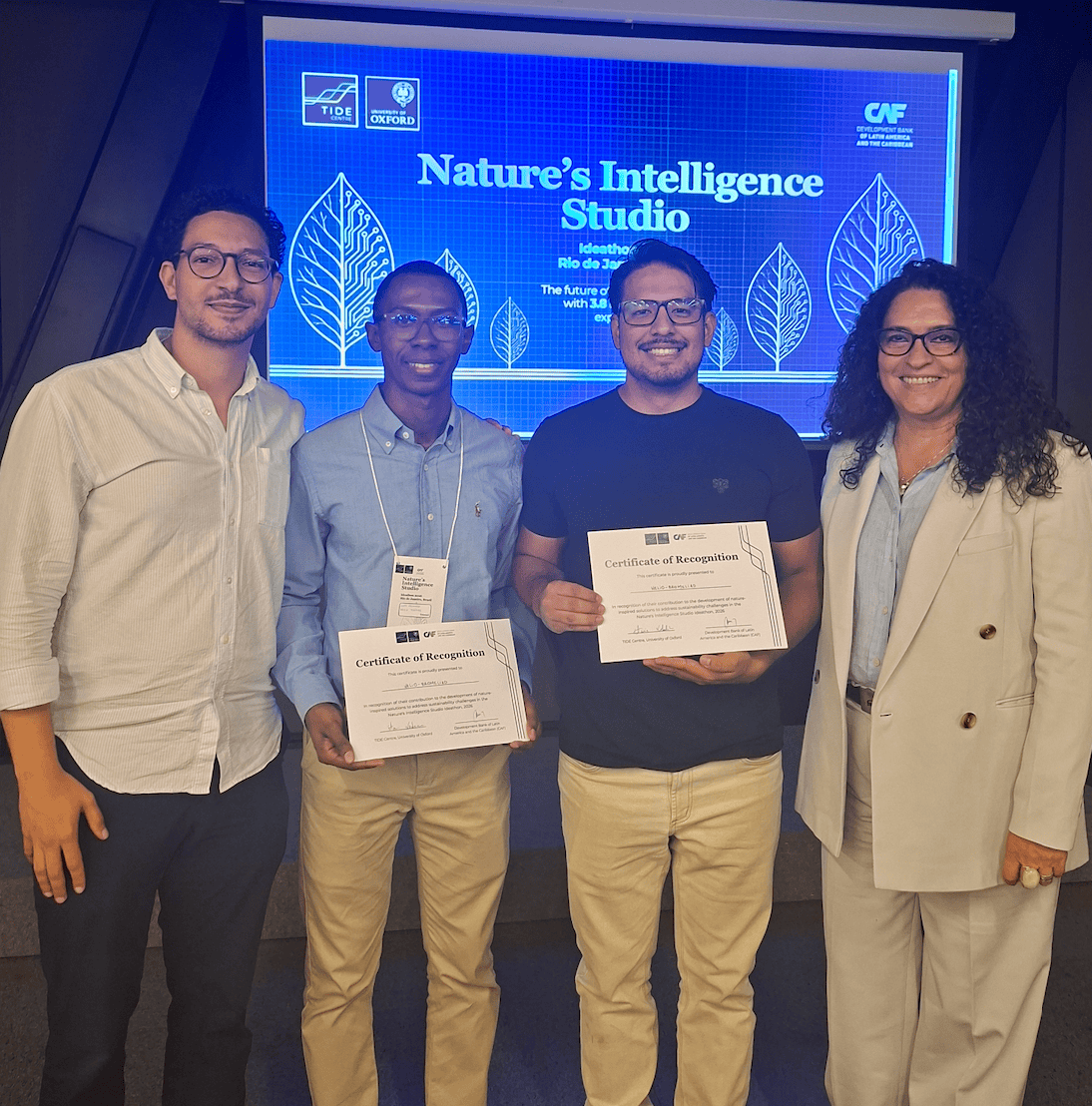
Luis Ferney Ortiz Torres, an Aspire Leaders Program 2024 alumnus from Colombia, was selected as one of ten finalists from more than 380 submissions across Latin America and the Caribbean for the first Nature’s Intelligence Studio, an innovation ideathon organized by CAF, Development Bank of Latin America and the Caribbean, and the TIDE Centre at the University of Oxford. His project, HELIO-BROMELIAD, looks to nature for solutions to rural electrification, drawing inspiration from Andean bromeliads to develop a modular solar energy system designed for cloudy, difficult to access regions. The recognition brought Ortiz to Rio de Janeiro, Brazil, where the experience helped transform years of scientific research into a broader mission centered on the communities his technology could serve.
From Hundreds of Ideas to Rio de Janeiro
Ortiz discovered the Nature’s Intelligence Studio while searching for funding opportunities to advance his existing research on artificial intelligence applied to microgrids. What initially appeared to be another potential source of support quickly became something different.
The ideathon challenged participants to approach nature as an engineering model and develop innovations inspired by biological systems. For Ortiz, the concept offered a new way of thinking about a problem he had already been studying: providing reliable energy to rural communities in the Andean tropics, where cloud cover, difficult terrain, and dispersed populations can limit the effectiveness of conventional solutions.
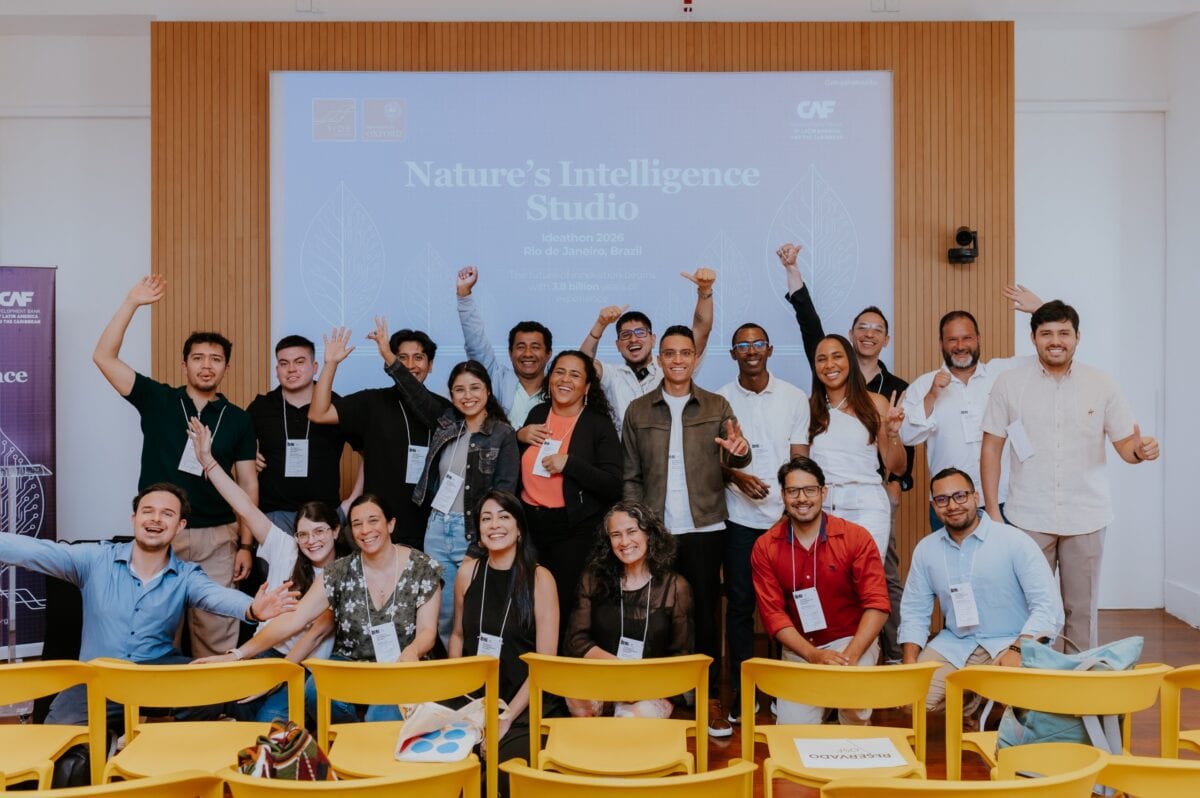
His proposal was evaluated by a panel of ten scientific experts and industry professionals before being selected among ten finalists from more than 380 submissions across Latin America and the Caribbean. That selection brought him to a retreat in Rio de Janeiro on August 3 and 4, where he joined researchers, engineers, and innovators exploring the intersection of nature, technology, and social impact.
For Ortiz, reaching the final ten carried particular significance because of the years of independent research behind the project.
“The moment we learned HELIO-BROMELIAD had been selected among the Top 10 out of more than 300 projects was memorable. But what moved me most deeply was what that meant beyond the ranking. It was the first time researchers from Oxford and CAF validated not just the idea, but the scientific rigor behind it,” he said.
Working largely independently and without the resources of a large laboratory or research team, Ortiz saw the recognition as confirmation that the publications, data, and algorithms he had spent years developing could become the foundation for something much larger.
What a Bromeliad Can Teach Us About Energy
At the center of Ortiz’s proposal was an unexpected source of engineering inspiration: the Andean bromeliad.
HELIO-BROMELIAD is a modular solar energy system inspired by the architecture of Tillandsia species, epiphytic plants that have adapted over millions of years to capture light and distribute resources efficiently in cloudy tropical environments. Ortiz translated the characteristics of the plant into an energy system designed for conditions where conventional solar technologies can face limitations.
The proposed system arranges solar panels in a spiral inspired by the plant’s structure, incorporates a micro-textured surface intended to improve the capture of diffuse light, and uses an artificial intelligence algorithm to determine how available energy should be distributed. The system was also designed to be modular, allowing installation on existing rooftops, poles, and community structures without requiring extensive civil works.
Its NIS-Flow algorithm uses Reinforcement Learning and Generative Adversarial Networks and was trained using 500 days of real data from the La Marina community in Colombia. The system is designed to prioritize essential services such as health centers, water systems, and communications when distributing available energy.
The scientific foundation behind the project has also extended into Ortiz’s academic work, including research accepted for CIGRE Paris 2026 and a publication in ENERLAC 2026.
Ortiz summarizes the philosophy behind the technology through the ecosystem that inspired it.
“The Andean bromeliad has been solving our energy problem for millions of years. We only had to listen to it. HELIO-BROMELIAD is our way of saying that nature and Colombian engineering together have what neither has alone, and that the communities that have waited longest for energy deserve solutions built from their own ecosystem, not imported from somewhere else.”
When Research Became a Human Story
The experience in Rio de Janeiro did more than validate HELIO-BROMELIAD’s technology. Conversations with experts from Oxford and CAF challenged Ortiz to consider what would be required for the project to move beyond a scientific proposal.
The jury encouraged participants to think not only about engineering, but also about communities, supply chains, and governance models. Those conversations changed the way Ortiz communicated the purpose behind his research.
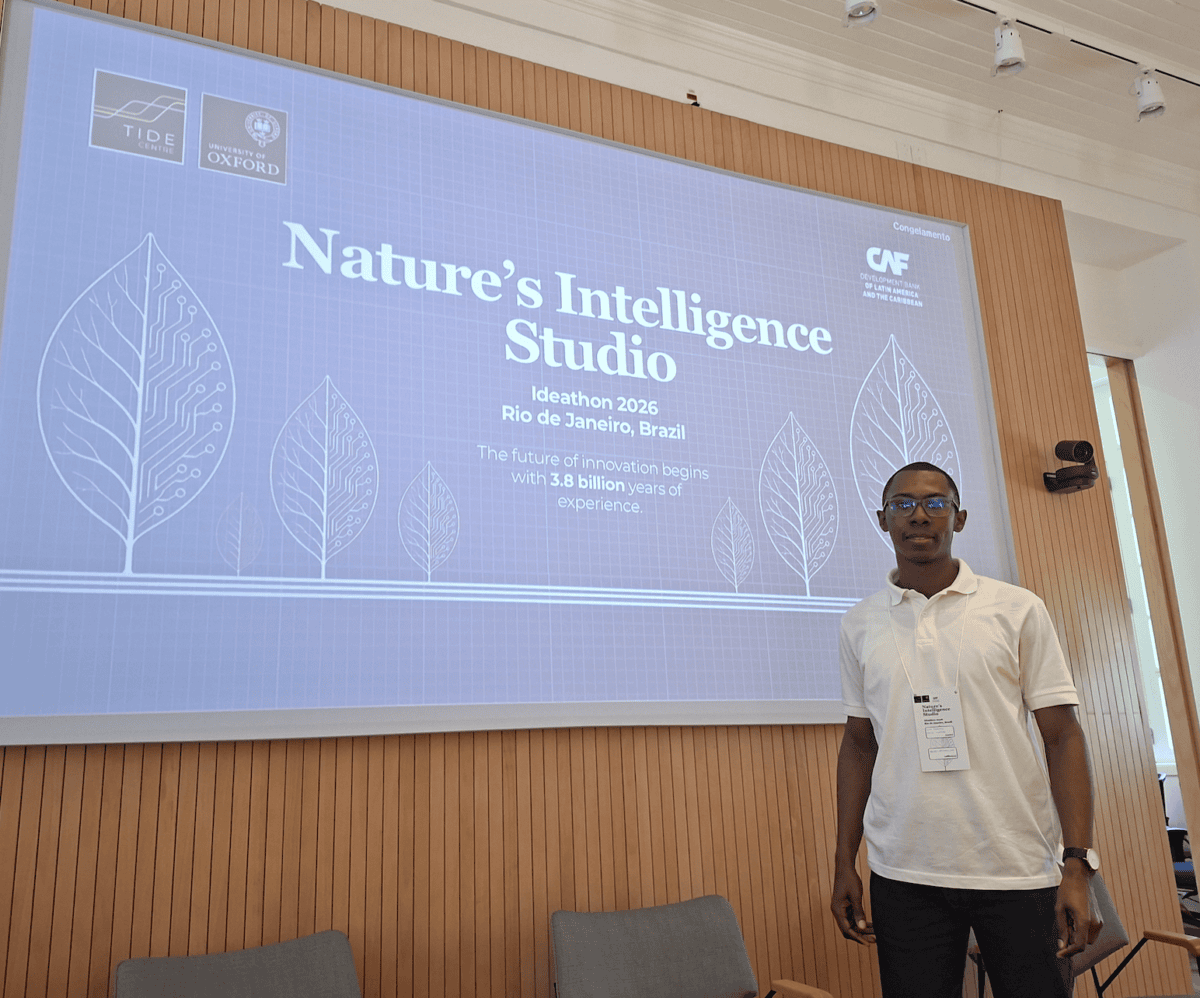
Before the ideathon, HELIO-BROMELIAD largely existed through data, algorithms, and academic publications. In Rio, Ortiz began connecting those technical achievements more directly to the people who could ultimately benefit from them.
“Through the competition, I learned to tell the human story behind the numbers: the nurse in Nariño who cannot refrigerate vaccines, the child in Putumayo who cannot study at night, the indigenous community leader in Boyacá who has waited years for an energy solution that understands their territory.”
That shift gave the project a clearer mission. Instead of viewing rural electrification exclusively as an engineering challenge, Ortiz began framing the technology around the everyday consequences of unreliable energy access and the importance of developing solutions responsive to the territories where they will operate.
The experience also introduced him to young researchers and innovators from throughout Latin America who were similarly exploring biomimicry as a rigorous methodology for addressing problems that conventional engineering approaches have struggled to solve.
Taking HELIO-BROMELIAD Beyond the Ideathon
Ortiz’s experience with the Nature’s Intelligence Studio has already begun creating new possibilities for the project.
Following the ideathon, he recently submitted HELIO-BROMELIAD to the APEC Youth 100 Shenzhen Dialogue and began conversations with Ecopetrol’s Econova innovation network and Colombia’s Ministry of Science about potential prototype funding.
His Aspire Leaders Program experience has formed another part of a journey increasingly focused on connecting technical knowledge with broader leadership and community impact. As HELIO-BROMELIAD moves from research toward potential implementation, the challenge ahead will be translating its scientific foundation into technology that can operate in the communities it was designed to serve.